

How do you make decisions when you make a personal purchase? What is any insights can you draw from this, when you price your business'service or products? Rafi Mohammed, author of The Art of Pricing, in his latest book, The 1% Windfall: How successful companies use price to profit and grow urges his readers to break out of their cost-plus or other "we've always done it this way" methods to instil a value-based pricing mindset within their organizations. He also challenges the conventional wisdom that market share and pricing are inversely related.
PRACTICE :: OPERATIONS
Delivering doors within a window
“You cannot time the market" is the conventional wisdom when it comes to investing in stock markets. However, in supply chain and logistics, timing is not only desirable, but often mandated, as Hindustan Aeronautics Ltd (HAL) discovered in its contract with an international customer.
HAL needed to deliver aircraft doors to its customer, but the delivery of doors outside a pre-specified window attracted a penalty. HAL faced significant supply chain management problems. These included things such as - when should it start the door's main assembly to overcome variability in the assembly process, how much inventory should it maintain for the more than 1000 components needed and how should it handle outsourcing.
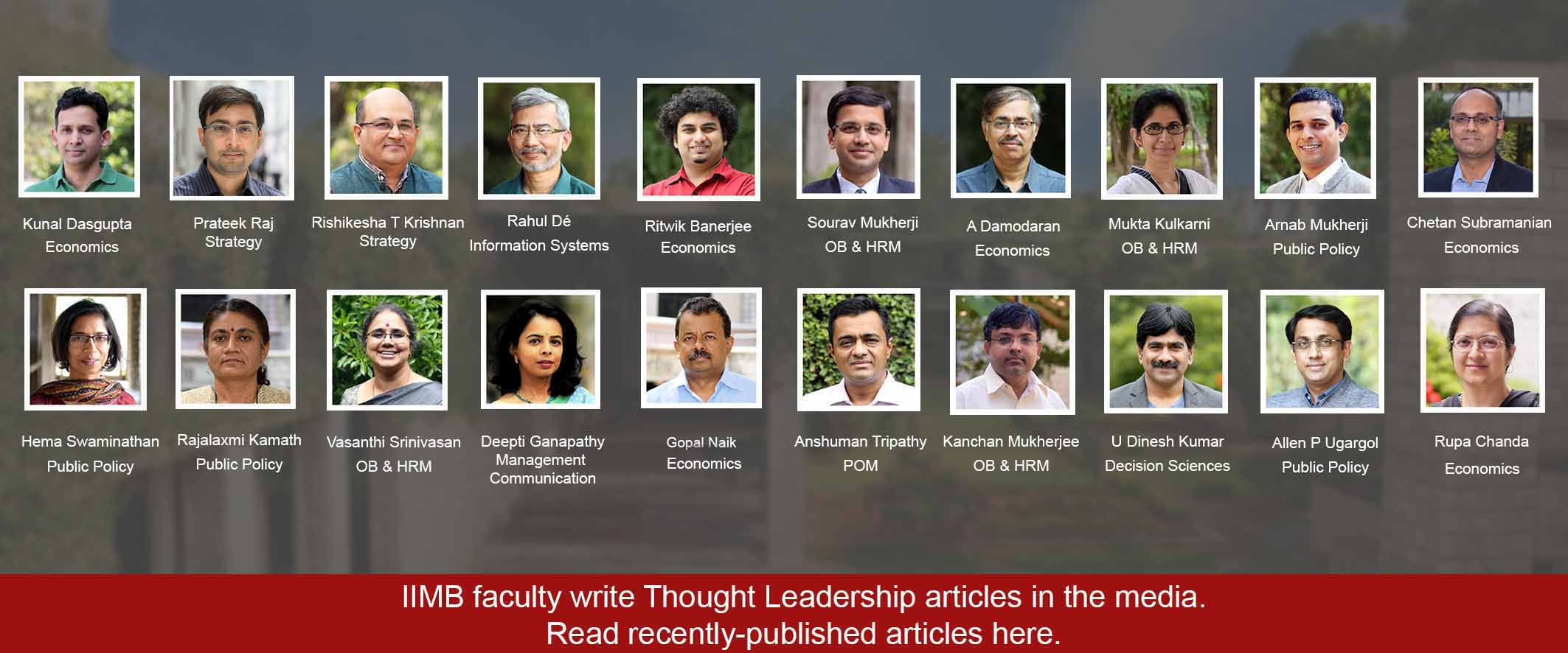
Professor Dinesh Kumar of the Indian Institute of Management Bangalore and his colleagues present a case on this complex issue of supply chain management. The case helps the reader comprehend supply chain issues, apply economic and stochastic techniques to address the challenges and devise probabilistic models to minimize the cost associated with non-conformance to delivery schedule.
INSIGHT :: MARKETING
Advertising successfully to India's cultural diversity
The rapid growth of social media and the mobile Internet is changing ways that businesses reach out to their customers and even more importantly how customers are influencing and shaping companies and their brands. Marketers everywhere are under pressure to deliver increased ROI and better metrics. The challenge for Indian marketers is in not only integrating these evolving communication channels, but in adapting them to India's unique diverse cultures and audiences.
Have firms, Indian and multinational, figured out the right integrated marketing communications mix to bridging India's traditional culture and the evolving modern world of its growing youth population? Professor S. Ramesh Kumar of IIM Bangalore has explored this question by analyzing mainstream media advertising campaigns and drawn some useful conclusions.
more..
VIEWPOINT :: ORGANIZATION & HR
Employing the disabled - is HR part of the problem?
Nearly two out of three organizations in a developed nation, such as the Netherlands, have difficulty finding employees. At the same time, more than 50% of people with disability find it difficult to get gainful employment in the same country.
What challenges do organizations and people with disabilities face when it comes to employing the disabled? What are organizations doing to facilitate integration of people with disability into the workforce? What do such employees expect from their employers? What is the role of HR in this process and are there lessons for India and Indian businesses?
Professor Mukta Kulkarni of the Indian Institute of Management, Bangalore and Reimara Valk of the Utrecht University, Netherlands studied a number of organizations in the Netherlands to answer these and other questions.
CORNER CASE :: STRATEGY
Coping with organizational change
How does a global supplier of technology and services cope with the changes sweeping the business landscape in today's world? How does it manage its own growth while dealing with the increased globalization and internationalization taking place?
The Bosch Group founded in 1886 has undergone many structural changes in a bid to stay competitive over time. In 2007, it initiated a series of changes seeking to transform itself into a translation organization. Its India operations, that had remained largely insulated from changes elsewhere within the organization, could not escape fundamental changes. Despite having done quite well as a business, the Bosch Group in India underwent increased integration with local and global operations of the company.
Professor Abhoy Ojha of the Indian Institute of Management Bangalore, studied the India operations of the Bosch Group to comprehend the challenges and opportunities in a geographic organization as it undergoes change thrust upon it in the global context. The case discusses the structural changes that take place in an organization that has been traditionally organizated as nearly self-contained geographical units. It discusses the challenges that these independent geographical units are confronted with as they undergo larger integration within the organization. Finally, it discusses the organizational dynamics when some of these units may not perceive the need to undergo change.